
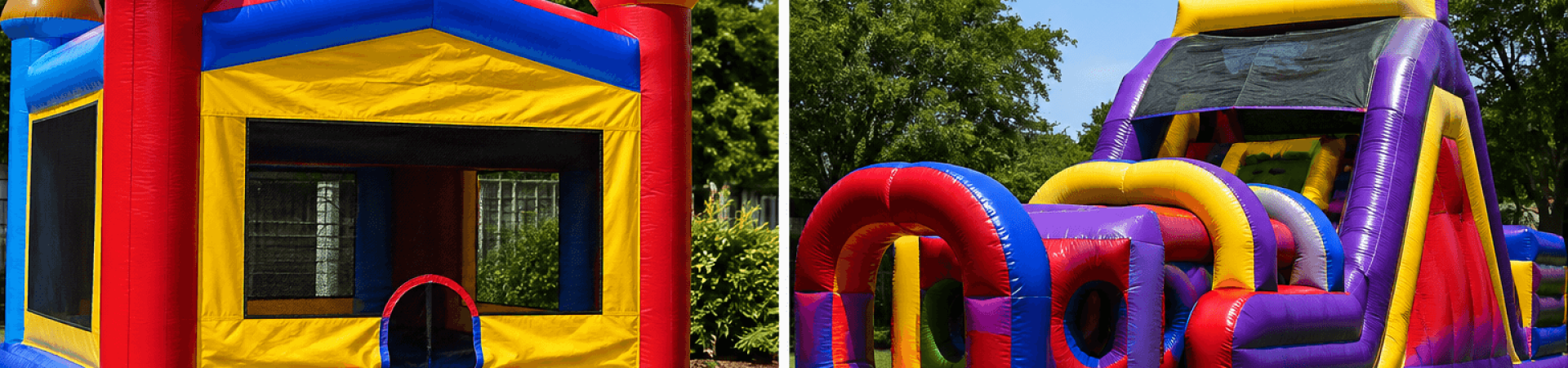
You’re planning a PTA fun day, field day rotation, or church festival with 30+ kids showing up at once. You know inflatables keep kids engaged, but you’re stuck on a practical question: which rental actually handles that crowd without turning into chaos?
The answer isn’t about which inflatable is “better.” It’s about throughput, supervision, and how kids actually use the space. An obstacle course processes kids in waves. A bounce house holds a small group at a time with no structured exit.
This guide breaks down capacity, setup requirements, supervision needs, and when each inflatable makes sense for large-group school events across Lafayette Parish and Acadiana.
What You’ll Learn
- How many kids each inflatable actually handles per hour
- Space and setup requirements for school grounds
- Supervision needs and volunteer management
- Which inflatable works for field day rotations vs open play
- When bounce house obstacle course combos make sense
- Common questions from PTA organizers and event planners
Which Type of Event Organizer Are You?
PTA / Field Day Coordinator
You need structured rotation for 4-6 classes moving through stations every 15 minutes. Lines must move fast. Volunteers are limited.
Best fit: Obstacle course anchor stations with timed heats
Church / Community Festival Planner
You have 2-3 hours of open play with kids cycling in and out. No strict schedule. Parents supervise their own kids mostly.
Best fit: Multiple bounce houses or combo units for variety
School Counselor / End-of-Year Event
You’re rewarding one grade level (60-90 kids) during a 90-minute celebration. Space is tight. You need maximum fun per square foot.
Best fit: One large obstacle course + one bounce house combo
How Many Kids Can Actually Use Each Inflatable Per Hour?
Capacity isn’t just about how many kids fit inside. It’s about how many kids get a turn when 30 are waiting in line.
Obstacle Course Throughput (Riders Per Hour)
A 46-foot two-lane obstacle course processes kids in waves. Two kids race head-to-head, complete the course in 45-60 seconds, exit, and the next pair enters immediately.
Real-world obstacle course capacity:
- 60-80 kids per hour with continuous rotation
- Each heat: 45-60 seconds (climb, crawl, slide, exit)
- 2 kids per heat × 60-70 heats/hour = high throughput
- One adult manages the entrance; kids self-exit at the slide
If you have 30 kids in line, everyone gets 2-3 turns within 30 minutes. That’s why obstacle courses dominate field day rotations.
Bounce House Capacity (Static Occupancy)
Most 15×15 bounce houses safely hold 6-8 kids at once. There’s no structured “exit”—kids bounce until they’re tired, then leave when they feel like it.
Real-world bounce house capacity:
- 6-8 kids inside at any moment (weight/size limits apply)
- Average session: 5-7 minutes per child
- Turnover depends on kids self-regulating energy
- No formal throughput—kids cycle in/out organically
If 30 kids want a turn, expect 20-30 minutes of waiting unless you enforce time limits. That works for casual festivals. It creates bottlenecks at timed school events.
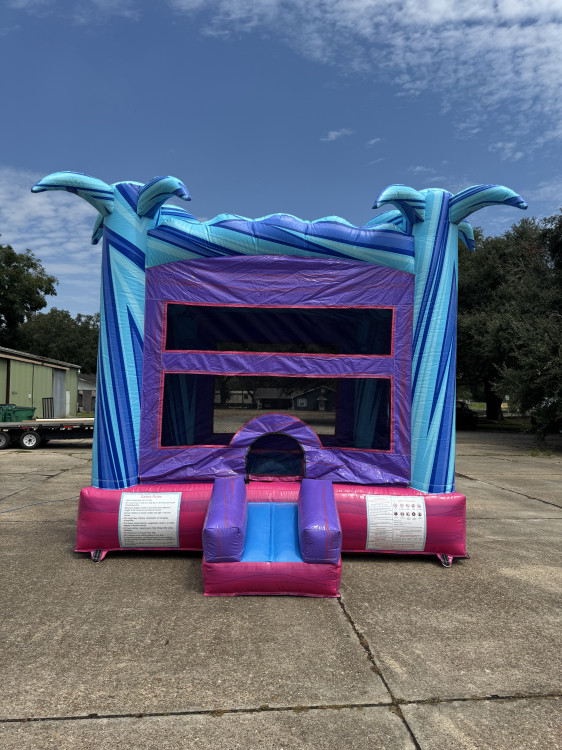
💡 Pro Tip: If your event schedule lists 15-minute station rotations, obstacle courses are the only inflatable type that guarantees every kid gets multiple turns within that window. Bounce houses need 20-30 minute blocks minimum.
Space Requirements: Which Inflatable Fits Your School Grounds?
Large obstacle courses and bounce houses need different footprints. One prioritizes length. One prioritizes open floor area.
46-52 Foot Models
- Footprint: 50×15 feet (750 sq ft)
- Setup time: 20-30 minutes to inflate/stake
- Best locations: Football fields, parking lots, long driveways
- Power needs: One 15-20 amp outlet within 100 feet
- Clearance: 3 feet on all sides for stakes and airflow
15×15 Standard Units
- Footprint: 17×17 feet (290 sq ft)
- Setup time: 10-15 minutes to inflate/stake
- Best locations: Courtyards, gyms, small lawns, tight corners
- Power needs: One 15 amp outlet within 75 feet
- Clearance: 2 feet on sides, 3 feet overhead for mesh roof
Obstacle courses need length—they won’t fit in square courtyards or narrow side yards. Bounce houses need floor area—they fit tighter spaces but don’t process lines as fast.
Most Lafayette Parish elementary schools use the football field or blacktop for obstacle courses during field day. Bounce houses go in shaded courtyards or alongside end-of-school celebration carnival games.
⚠️ Setup Timing: If your event starts at 9 AM, inflatables should begin setup by 8:15 AM (obstacle course) or 8:30 AM (bounce house). Both need access to power outlets—plan extension cord routes in advance.
Supervision Needs: Which Inflatable Is Easier to Monitor?
Volunteer availability drives inflatable choice at most school events. Some inflatables need constant monitoring. Others run with minimal oversight.
Obstacle Course Supervision (Lower Volunteer Burden)
One adult stands at the entrance and manages the start of each heat. Kids race through solo or in pairs, self-regulate inside the course, and exit via the slide. The structure enforces the rules.
Obstacle course supervision checklist:
- ✓ One volunteer at entrance (manages line, starts heats)
- ✓ Optional second volunteer at slide exit (catches stragglers)
- ✓ Kids move single-file through obstacles—no collisions
- ✓ Clear entry/exit flow reduces chaos
Supervision ratio: 1 adult per 20-30 kids works safely because the course itself creates order.
Bounce House Supervision (Higher Volunteer Demand)
Bounce houses need active monitoring inside to prevent collisions, size mismatches (big kids bouncing with toddlers), and overcrowding. There’s no structured flow—kids bounce randomly.
Bounce house supervision checklist:
- ✓ One volunteer inside or at entrance (watches for roughhousing)
- ✓ Enforce size/age grouping (no 10-year-olds with 5-year-olds)
- ✓ Monitor capacity limits (6-8 kids max for most 15×15 units)
- ✓ Manage entry/exit timing to avoid overcrowding
Supervision ratio: 1 adult per 8-10 kids actively bouncing. Open bounce houses at church festivals often run with parent-supervised play, but school events need dedicated monitors.
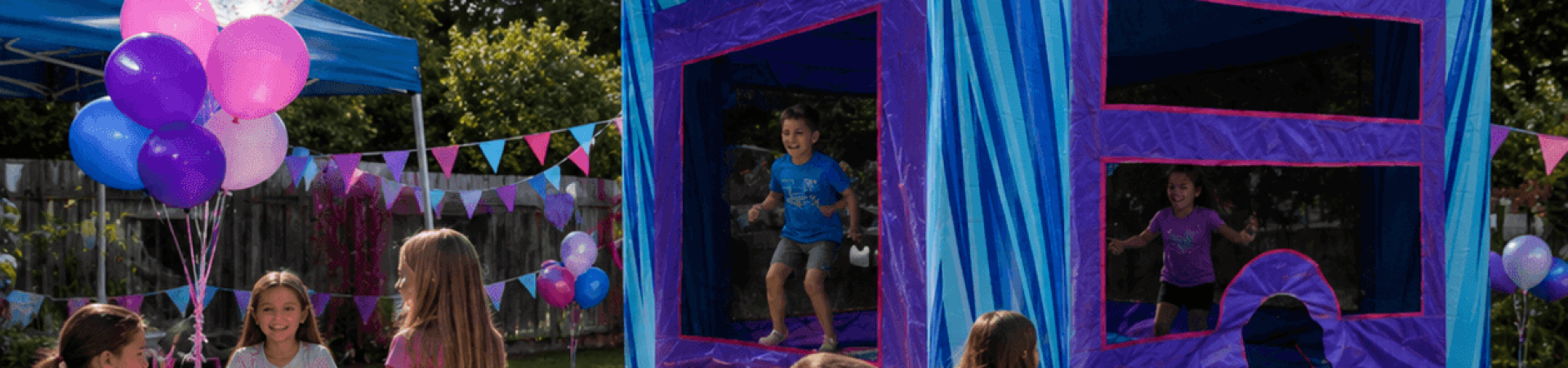
For events with limited parent volunteers, obstacle courses reduce supervision stress because the racing format creates natural order. For casual festivals where parents watch their own kids, bounce houses work fine.
Field Day Rotations vs Open Play: Which Inflatable Fits Your Event Format?
The structure of your event determines which inflatable works. Timed rotations demand throughput. Open play rewards variety and low-pressure fun.
Timed Rotation Events (Field Day, Class Parties with Stations)
If kids rotate through stations every 10-15 minutes, you need guaranteed turns for everyone in that window. Obstacle courses deliver.
Why obstacle courses dominate field day schedules:
- Each class (20-25 kids) rotates in, everyone races 2-3 times, rotates out
- No lines building up across multiple rotations
- Teachers can predict timing—no “we need 5 more minutes” chaos
- Two-lane racing format creates excitement and competition
Bounce houses work as secondary stations in rotation schedules, but they can’t serve as anchor activities. The lack of structured throughput creates bottlenecks.
Open Play Events (Church Festivals, PTA Fun Nights, End-of-Year Celebrations)
When kids have 2-3 hours to roam freely between activities, bounce houses shine. No one’s watching the clock. Kids cycle in and out naturally.
Why bounce houses work for open play festivals:
- Kids bounce for 5-7 minutes, leave when tired, come back later
- No pressure to “get your turn” before rotation ends
- Parents supervise their own kids—less volunteer coordination
- Multiple bounce houses create variety (castle theme, sports theme, etc.)
For maximum engagement at open-play events, many organizers rent one obstacle course + two bounce houses. The obstacle course anchors competitive play. Bounce houses offer low-pressure variety.
Planning a celebration where kids have time to explore? Our guide on stress-free party planning covers multi-activity setups that keep energy balanced.
When Does a Bounce House Obstacle Course Combo Make Sense?
Combo units blend a small bounce area with a short obstacle lane and slide—usually 30-35 feet total. These work well for smaller groups or as one station in a multi-activity rotation.
What You Get in a 9×35 Combo Unit
Bounce area:
- Small 9×9 bounce floor
- Holds 4-5 kids safely
- Entry point before obstacle lane
Obstacle lane:
- Pop-up barriers or crawl-through tunnels
- 15-20 feet of racing length
- Ends with a slide exit
Capacity:
- 30-40 kids per hour throughput
- Best for 15-20 kid groups
- Faster than pure bounce, slower than full obstacle
Combos split the difference: they offer variety in a single footprint but don’t match the throughput of a dedicated 46-foot obstacle course.
Best Use Cases for Combo Units
- Classroom parties: 15-20 kids, 60-90 minute event, limited space
- Secondary stations: One of 3-4 activities at a larger festival
- Backyard birthday parties: Mixing bounce play with racing competition
- Church youth groups: Mid-sized gatherings (20-30 kids) with 2-hour windows
For 30+ kids rotating through timed stations, combos still create bottlenecks. For smaller groups or casual play, they deliver two activities in one rental.
Real-World Event Scenarios: Which Inflatable Should You Choose?
Here’s how event type, group size, and schedule structure determine the best inflatable choice.
Elementary School Field Day
Group size: 300-400 kids (6 classes rotating)
Schedule: 15-minute rotations, 6 stations
Best choice: Two 46-foot obstacle courses as anchor stations + relay races and field games at other stations
Why: Obstacle courses guarantee throughput. Every kid gets 2-3 turns per rotation.
Church Fall Festival
Group size: 60-100 kids (ages 3-12)
Schedule: 3 hours open play
Best choice: Three bounce houses (toddler, elementary, tween sizes) + carnival games
Why: Kids self-regulate play. Variety keeps interest high. Parents supervise their own kids.
5th Grade End-of-Year Party
Group size: 75 kids (one grade level)
Schedule: 90-minute celebration on blacktop
Best choice: One 52-foot obstacle course + one bounce house combo unit
Why: Obstacle course handles competitive racing. Combo offers chill bounce time. Two activities = no boredom.
For more ideas on structuring end-of-year celebrations, check out our guide to end-of-school party setups that balance energy and supervision needs.
Frequently Asked Questions
Which inflatable handles more kids at once, a bounce house or an obstacle course?
Obstacle courses move more kids per hour. A 46-foot two-lane obstacle course processes 60-80 kids hourly, while most 15×15 bounce houses safely hold 6-8 kids at a time with no structured throughput. For 30+ kids at a school event, obstacle courses handle volume better through continuous rotation.
How much space does a large obstacle course need compared to a bounce house?
A 46-foot obstacle course needs a clear footprint of roughly 50×15 feet (750 square feet), while a standard bounce house uses about 17×17 feet (290 square feet). Obstacle courses require longer, narrower spaces—ideal for school fields or parking lots with length. Bounce houses fit tighter areas like courtyards or small yards.
Can you rent a bounce house obstacle course combo for schools?
Yes. Bounce house obstacle course combos combine a small bounce area with a short racing lane, typically in a 30-35 foot footprint. These work well for smaller groups (15-20 kids) or as one station in a multi-activity rotation. For 30+ kids, standalone obstacle courses or multiple units work better.
Which is easier to supervise at a school event—bounce house or obstacle course?
Obstacle courses are easier to supervise with one adult at the entrance. Kids enter one at a time, race through, and exit—clear flow. Bounce houses need continuous monitoring inside to manage roughhousing and collisions. For volunteer-heavy events like field days, obstacle courses reduce supervision burden.
How long does it take to set up a large obstacle course for a PTA event?
A 46-52 foot obstacle course takes 20-30 minutes to inflate and stake. Bounce houses inflate in 10-15 minutes. If your event starts at 9 AM, plan for setup to begin by 8:15 AM for obstacle courses, 8:30 AM for bounce houses. Both need access to 15-20 amp power outlets.
Do Lafayette Parish schools prefer obstacle courses or bounce houses for field day?
Most Lafayette Parish elementary schools use obstacle courses as anchor stations during field day because they rotate large groups efficiently. Bounce houses appear as secondary stations or for smaller classroom parties. The choice depends on whether you need throughput (obstacle course) or open play (bounce house).
Choosing the Right Inflatable for Your Event
The obstacle course vs bounce house decision comes down to event structure, group size, and supervision capacity—not which inflatable is inherently “better.”
If you’re running timed rotations with 20-30 kids per station and limited volunteers, obstacle courses deliver guaranteed throughput. If you have 2-3 hours of open play with parent supervision, bounce houses create low-pressure variety.
For hybrid events—like end-of-year celebrations or PTA fun nights—many organizers rent one obstacle course + one or two bounce houses. The obstacle course anchors competitive play. Bounce houses offer chill bounce time for kids who need a break.
Understanding how kids actually use each inflatable—and how volunteers manage flow—helps you plan events that feel organized, not chaotic.
Planning Your Next School Event?
Whether you need high-throughput obstacle courses for field day or a mix of inflatables for a festival, choosing the right setup makes the difference between smooth rotations and bottlenecked lines.
No pressure, no pitch—just help planning an event that actually works for 30+ kids.